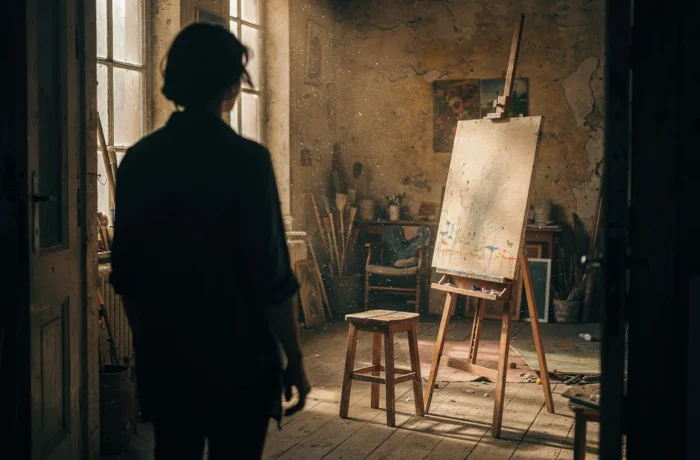
Go and look at where you keep the unfinished work. The canvases turned to face the wall. The folder of drafts. The files named final, final2, and final_actual. Most working artists have a pile like this, and most feel a low grade shame about it.
The pile is usually explained as a discipline problem. You start things and you do not finish them, therefore you lack follow through. That explanation is common, it feels true, and it does not survive contact with the evidence. People who lack follow through do not accumulate work that is ninety percent complete. They stop at ten percent, because they stopped caring.
Work abandoned near the end is not evidence of indifference. It is evidence of something that gets harder as completion approaches, and that is a different problem with a different mechanism.
The unfinished pile is not a discipline problem
Consider what it takes to get a piece to ninety percent. Sustained attention over days or weeks. Hundreds of decisions. Repeated returns to the same problem. That is follow through by any reasonable definition.
Then, somewhere near the end, it stops. Not with a decision to abandon it. Usually with a gradual cooling, a few more days between sessions, and eventually the quiet understanding that you are not going back to it.
Whatever is happening is happening at a specific point in the process, and it is happening reliably. Reliable and specific means mechanism, not character.
Perfectionism is not high standards
These get treated as the same thing and they behave completely differently.
High standards are applied to the work. They produce revision, attention, and refusal to release something weak. They are compatible with finishing, because the standard is a description of what the work needs to be.
Perfectionism is applied to you. The standard is not a description of the work, it is a condition for your acceptability. Under that arrangement finishing is dangerous, because a finished piece can be measured, and if it falls short the shortfall is about you.
This is why perfectionism and high standards produce opposite results. One drives work towards completion. The other stops it just before the point of measurement.
Why the standard rises as you get closer
Early in a piece, the work is potential. It could still become anything. At that stage it is easy to be generous with it, because nothing has been decided.
As it takes shape, possibilities close. Every decision that improves the piece also removes the versions it might have been. By the late stages you are no longer comparing the work to nothing. You are comparing it to the ideal version that existed in your head before you started, and against that comparison a real object always loses.
So the closer you get, the worse it looks, not because it is getting worse but because the comparison is getting more concrete. Many artists describe hating a piece most at the point where an outside eye would say it is nearly there.
Decision paralysis and the cost of open options
Late stage work is dense with small decisions. Is it finished. Does that edge need softening. Is the whole thing a mistake. Should this go back three steps.
Each of those is low information and high stakes, which is the worst combination for deciding. There is no external fact to settle them, so they rest entirely on your judgement, and your judgement is the thing you have been doubting.
Faced with that, postponement is rational. Not deciding preserves every option. The work stays alive in a state where it could still become the thing you imagined. The cost is that it never becomes anything.
The wall at ninety percent
The last ten percent has a particular character. The interesting problems are solved. What remains is refinement, and refinement is where the gap between your taste and your execution is most exposed.
In the messy middle the work is obviously incomplete, so its faults are excusable. Near the end there is no excuse left. Every remaining flaw is now a flaw in a finished object rather than a stage in an unfinished one.
That shift is what people hit. It is not boredom, and it is not the fun part being over. It is the removal of the protection that incompleteness was providing.
Why finishing feels like exposure
An unfinished piece cannot be judged. That is its great advantage.
While the work is in progress you can hold two things at once, the object as it is and the object as it will be, and the second one is always better. Finishing collapses that. What exists is what exists, and it can now be compared to other people’s finished work, to your own past work, and to what you told yourself you were capable of.
If your work is entangled with your identity, and for most makers it is, then releasing a finished piece is not releasing an object. It is submitting evidence. The reluctance is proportionate to what you believe is being evidenced.
Revision as avoidance
This one is uncomfortable, because it wears the clothes of diligence.
There is revision that improves work, and there is revision that keeps a piece in the safe state of being not yet finished. They look identical from the outside and they feel different from the inside. Productive revision has a direction. You know what problem you are solving. Avoidant revision circles, undoes yesterday’s changes, and never arrives.
A useful test is whether the piece is getting better or merely getting different. Another is whether you could describe what would make it done. If you cannot answer that after weeks of work, the revising may be doing a job other than improving the piece.
Starting new work as escape
The relief of a new project is real and it is worth understanding.
A new idea is pure potential, with none of the compromises the current piece has accumulated. It offers exactly what the late stage work has stopped offering, which is the pleasant condition of not yet being measurable.
This is why blocked artists often have plenty of ideas. The ideas are not the problem, and their abundance is sometimes part of the pattern. Each new one provides a legitimate looking reason to step away from the one approaching judgement.
Comparison and other people’s finished work
You compare your unfinished, flawed, close up work to other people’s finished, edited, published work. Everyone knows this is unfair. Knowing it changes very little, because the comparison does not run consciously.
What makes it worse near the end of a project is that your work is finally comparable. In the middle it was clearly a different kind of object. Now it is the same kind of object as theirs, and the differences are legible.
The relevant point is not that comparison is irrational. It is that it intensifies at precisely the stage where you most need to be able to make decisions calmly.
Why constraints help more than freedom
Artists often believe more freedom would help. Usually more constraint does.
Constraints reduce the number of open decisions, and open decisions are what the paralysis feeds on. A fixed size, a limited palette, a set deadline, a rule about what you are not allowed to change. Each one removes a question that could otherwise be argued about indefinitely.
Constraint also gives you something other than your own judgement to point at when deciding. It is finished because it meets the brief, rather than because you have declared it good enough, and the second is much harder to say.
What changes when finishing stops being a verdict
Everything in this article comes back to a single arrangement. Finishing has been set up as a moment of measurement, and measurement is being applied to you rather than to the work.
While that arrangement holds, no amount of discipline will fix the pile, because the pile is not caused by insufficient discipline. It is caused by a sensible reluctance to walk into a judgement.
Change the arrangement and the behaviour changes on its own. That is the level at which hypnotherapy and NLP operate, working with the learned association between completion and exposure rather than trying to argue you out of a feeling that was never built by argument.
The final article in this series deals with the practical question underneath all of this, which is how you actually return to the work when you have been away from it, and why waiting until you feel ready keeps you waiting.
Why do I never finish my art?
Most often because finishing is where the work becomes measurable, and measurement has been attached to your worth rather than to the piece. An unfinished work is protected from judgement, so stopping short is a way of keeping it safe. This is why the pattern shows up in people who work hard and care a great deal, rather than in people who do not.
Why do I abandon projects at ninety percent?
Because the last stretch removes the protection that incompleteness was providing. In the middle, flaws are stages. At the end, flaws are permanent features of a finished object. The cooling off you feel near completion is usually not lost interest, it is the approach of judgement, and the timing is the clue.
Is perfectionism holding back my art?
If your standard is applied to the work, it drives quality and is compatible with finishing. If it is applied to you, so that a flawed piece means something about your worth, then it will tend to prevent completion, because completion allows measurement. The distinction is not how high the bar is. It is what the bar is measuring.
Why do I keep starting new projects instead of finishing old ones?
A new project offers pure potential and no possibility of falling short yet, which is exactly what a nearly finished piece has stopped offering. Starting something new provides genuine relief and a reasonable sounding justification for stepping away. Having many ideas is not the problem, but the timing of when new ideas become urgent is worth watching.
How do I know when a piece is finished?
Without an external constraint this is very difficult, because there is no fact to settle it. Most experienced makers rely on a defined brief, a deadline, or a rule set before starting, rather than on a feeling of rightness that may never arrive. Deciding what done means before you begin removes a decision that is nearly impossible to make at the end.
Why do I hate my work when it is nearly done?
Because you are now comparing a real object to the ideal version that existed before you started, and the ideal version was never subject to the limits of materials, time, or hands. That comparison gets sharper as the piece resolves. Peak dislike near completion is so common that it is closer to a stage of the process than a signal about quality.
Why do I have so many unfinished pieces?
Because each one stalled at the same point for the same reason, and the pile accumulates. It is worth noticing that a large pile of nearly complete work is evidence of sustained effort, not of laziness. What it indicates is a consistent obstacle near completion rather than a failure of commitment.
Does perfectionism mean I have high standards?
Not necessarily, and the two often pull in opposite directions. High standards produce finished work that has been revised until it is good. Perfectionism frequently produces no finished work at all, which means the standard is never actually applied to anything. The outcome is the clearest test of which one is operating.
Why is it easier to start than to finish?
At the start the work is potential and cannot yet fall short. At the end it is an object that can be measured against everything. If the difficulty is at the beginning it usually concerns whether you can do it. If it is at the end it usually concerns what the result will say about you.
How do artists decide when to stop?
Most working artists use external markers rather than internal certainty. A deadline, a brief, a show, a client, or a rule agreed in advance. Waiting for the piece to feel done tends to fail, because in a perfectionist pattern that feeling is precisely the thing that never arrives.
Why do I compare my work to other artists?
Because it happens automatically and below the level of choice, and it intensifies when your work reaches a comparable state. Knowing the comparison is unfair does not stop it, because it was never a reasoned conclusion. What can change is how much weight the comparison carries when you are making a decision about your own piece.
Can perfectionism be useful?
The underlying care is useful, and it is usually the reason the work is good. What is not useful is applying that care to yourself as a condition of acceptability rather than to the work as a description of quality. The aim is not to care less. It is to change what the standard is being applied to.