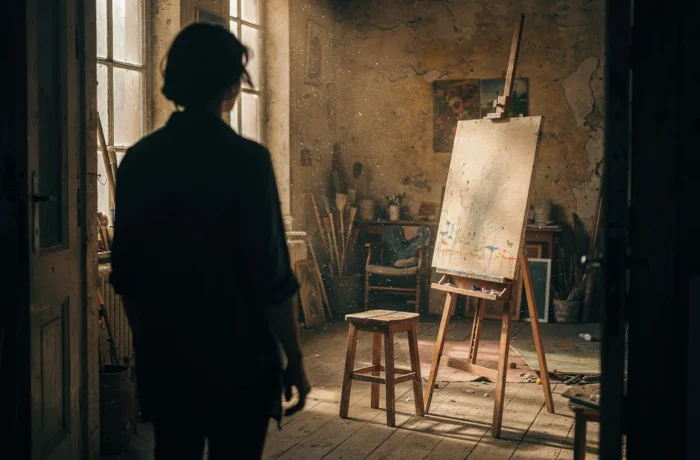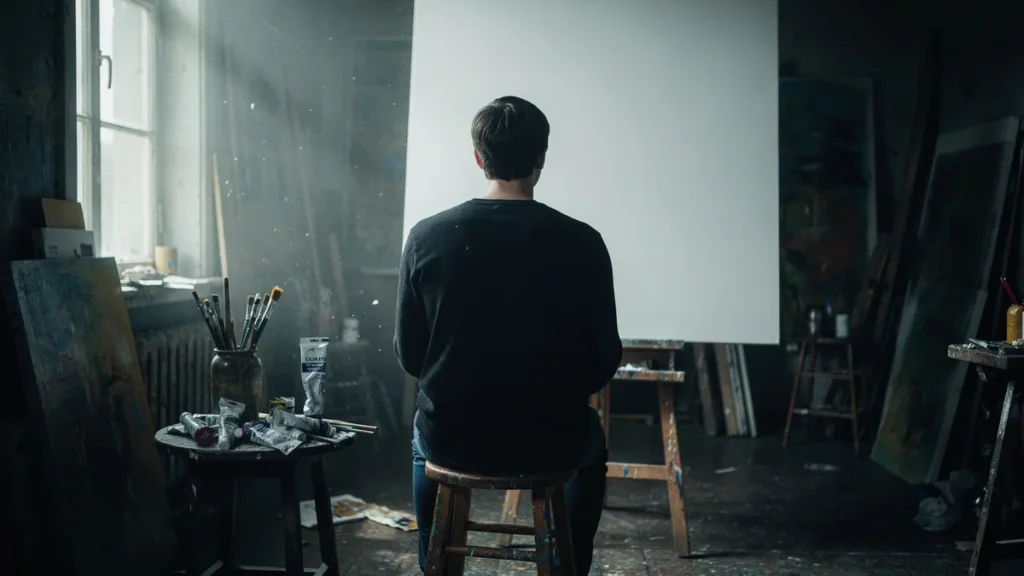
You have the time. The materials are out. You have wanted this all week, and now you are sitting in front of the work and nothing is moving. Not a shortage of ideas, exactly. Not tiredness, exactly. Something closer to a wall that appears the moment you reach for the brush, the pen, the keyboard, the clay. You can think about the work. You can talk about the work. You cannot start the work.
If you have been calling that laziness, this article is going to disagree with you. The freeze in front of a blank surface is not an absence of discipline and it is not evidence that whatever you had has gone. It is a protective response, and it follows rules. Once you can see the rules, the whole thing stops looking like a character flaw and starts looking like something with a mechanism.
The freeze is not laziness
Laziness would feel like not caring. This does not feel like not caring. It feels like caring so much that approaching the work has become uncomfortable, and then feeling guilty about the discomfort, and then avoiding the thing that produces the guilt.
Notice what actually happens in the moment. You sit down. There is a small rise of something in the chest or the stomach. Your attention slides sideways to the phone, the kettle, the tidying, the research you could do first. You are not choosing that slide. It happens faster than choosing. By the time you notice, you are already somewhere else.
That speed matters. Deliberate decisions are slow and you can feel yourself making them. This is not slow. It has the signature of a reflex, which is exactly what it is.
What a blank surface actually asks of you
An empty canvas looks like an invitation. To a nervous system that has learned to associate the work with judgement, it reads as a demand.
The demand is not to make a mark. The demand is to make a mark that proves something. Proves you still have it. Proves the last good piece was not luck. Proves the time you have spent on this life was reasonable. No single brushstroke can carry that, which is why the first mark becomes so heavy that it does not get made.
This is why the freeze is so specific to work that matters. The stakes are not in the surface. They are in what you have quietly attached to it.
Why the stakes climb while you wait
There is a cruel arithmetic in a block that lasts. A week away from the work is a week. Six months away becomes a story about yourself.
Each day you do not start, the first piece you eventually make has to justify the gap. It has to be good enough to explain the silence. So the bar rises while your practice, which is a physical skill maintained by repetition, quietly drops. The distance between what you demand and what you can currently produce widens, and the widening itself becomes another reason not to begin.
People often describe this as losing confidence. It is more accurate to say the entry price went up.
The gap between the work you imagine and the work your hands make
Every maker lives with a gap between taste and execution. Your taste is educated. You can see what good work looks like. Your hands, on any given day, produce something short of that.
Working artists tolerate this gap daily. It is the ordinary condition of making things. What changes during a block is not the size of the gap but your relationship to it. The gap stops reading as normal friction and starts reading as verdict.
Once the gap means something about you rather than about the difficulty of the task, looking at your own unfinished work becomes uncomfortable, and the studio becomes a place where uncomfortable feelings live.
Why the advice to just start does not reach it
You have already been told to just start. You have probably told yourself, in a firmer voice than anyone else would use. If instruction worked, the block would have ended the first week.
The reason it does not work is that the instruction is aimed at the wrong system. Deciding to start is a conscious act. The response that stops you is not conscious, and it is faster. By the time your intention arrives, the avoidance has already run.
This is the same pattern that shows up in other places where effort backfires. Telling yourself to relax when you are anxious tends to sharpen the anxiety. Telling yourself to sleep keeps you awake. Willpower is a conscious tool, and the patterns that limit creative work are not held consciously. Applying more of a tool that cannot reach the level where the problem lives produces more strain and the same result.
The protective logic underneath the block
Nothing your mind does repeatedly is random. If a response persists, it is doing a job.
Consider what the freeze protects you from. If you do not start, the work cannot be bad. If the work is not bad, you do not have to find out whether the fear is true. If you never test it, the identity survives intact. Not starting is a way of keeping the question open, and an open question hurts less than a bad answer.
Seen that way, the block is not sabotage. It is a strategy for managing exposure, built by a part of you that is trying to prevent a specific kind of pain. It is working. That is the problem. It is doing its job so well that it also prevents the work.
How avoidance teaches itself
Here is the loop that keeps it running.
You approach the work. Discomfort rises. You turn away. The discomfort drops immediately, and that drop is the important part. Relief is a reward, and rewards teach. Your nervous system files the sequence away as useful information: approaching that thing produced discomfort, turning away produced relief, therefore turning away is correct.
You did not agree to this lesson. It was learned by repetition, the way all conditioned responses are learned. And every repetition makes the next approach slightly harder, because the association is now slightly stronger.
This is why blocks tend to deepen rather than plateau. The avoidance is not a symptom of the block. It is the mechanism maintaining it.
Why it spreads beyond one piece
Blocks rarely stay tidy. What begins with one difficult commission spreads to the sketchbook, then to the idea of the studio, then to talking about your work at all.
Conditioned responses generalise. Anything that resembles the original trigger can start to pull the same reaction, and the resemblance does not have to be close. The smell of the materials. The room. A message asking what you are working on.
Artists often describe this stage as the block becoming who they are rather than something they are experiencing. That shift is worth naming, because it is the point where people stop looking for a mechanism and start accepting a verdict.
When the work is tangled with who you are
For most makers, the work is not a hobby that sits beside the self. It is load bearing. It is how you process, how you are known, and often how you earn.
That entanglement raises the stakes of every mark. When your work is your identity, a weak piece is not a weak piece. It is information about your worth. No wonder the hand hesitates.
It also explains the guilt that runs underneath a block, which is often heavier than the block itself. Time away from the work does not feel like time away from a task. It feels like time away from yourself.
Rest and blockage are not the same thing
One useful distinction, because they are frequently confused.
Rest has a settled quality. You are not making, and you are not at war about it. Input is going in. Curiosity is intact. You look at other people’s work with interest rather than with a knot.
A block has tension in it. You want to be working, you are not working, and the not working costs you something every day. Curiosity has narrowed. Other people’s work produces comparison rather than interest.
If you are resting, the answer is to rest properly and stop calling it failure. If you are blocked, more rest will not resolve it, because the pattern is not fatigue.
Lowering the stakes instead of raising the effort
The instinct in a block is to raise effort. Try harder, commit more, make a bigger plan, promise yourself a stricter routine. Every one of those raises the stakes of the next attempt, and stakes are the thing that jammed the mechanism in the first place.
The direction that makes sense is the opposite one. Not more force, but less at risk in a single attempt. A mark that is allowed to be bad. Fifteen minutes that are not allowed to become a verdict on your future. Work with no audience attached to it.
This is also where approaches that address the subconscious level become relevant. Hypnotherapy and NLP work with conditioned responses directly, at the level where the association between the work and the threat was learned, rather than arguing with it consciously. The aim is to change what the blank surface signals to your nervous system, so that approaching it no longer triggers the guard.
That is the subject of the next article in this series, which looks at the inner critic, the flow state, and why trying harder to be creative reliably shuts creativity down.
Why can I not make art anymore?
In most cases the ability has not gone anywhere. What has changed is the meaning attached to making. When the work becomes a test of your worth rather than a thing you do, approaching it triggers a protective response, and that response is faster than your intention to start. The skill is still there. Access to it is what has narrowed.
Is art block real, or am I just being lazy?
It is real, and laziness is the wrong description. Laziness would feel indifferent. A block feels like wanting to work, being unable to begin, and suffering over the gap. That combination is not an absence of motivation. It is motivation meeting an obstacle, and the obstacle is a learned response rather than a character defect.
Why do I freeze in front of a blank canvas?
Because a blank surface offers no constraints, and unlimited choice raises the weight of the first decision. If the first mark has to be right, and right has been defined as proof that you are still any good, then no mark is safe enough to make. The freeze is what happens when the perceived stakes of a small action rise higher than the action can carry.
How long does art block usually last?
It varies widely, from days to years. Duration is less about the original cause and more about how long the avoidance loop has been running, because each avoidance strengthens the association slightly. That is why blocks tend to deepen over time rather than fade on their own, and why length is not a measure of how serious the underlying issue is.
Does art block mean I have lost my talent?
No. Skill is built by repetition and it degrades slowly with disuse, but it does not vanish. What people experience as lost talent is usually two things happening at once: a raised internal standard, because the gap has to be justified now, and reduced recent practice. The distance between those two feels like loss. It is a gap in access, not in ability.
Why is starting harder than continuing?
Because starting is where the evaluation happens. Once you are moving, attention is occupied by the task and there is less room for self monitoring. The threshold sits at the beginning, which is exactly why sessions often go well once you are twenty minutes in, and why that experience does not make the next start any easier.
Why can I sketch for fun but not work on my real project?
Because the stakes are not equal. A sketch nobody will see carries no verdict, so no protective response is triggered. The real project carries the meaning, and the meaning is what the block is responding to. This is useful evidence, not a contradiction. It demonstrates that your hands and your ideas are working, and that the obstacle is specific to the perceived stakes.
Why do I feel anxious when I sit down to create?
Anticipatory anxiety arrives before the task does. If previous attempts have ended in frustration or self criticism, your nervous system learns to predict that outcome and prepares for it in advance. The physical sensation is a preparation for a threat, and the threat it has learned to expect is judgement, usually your own.
Does forcing myself to create help?
Forcing occasionally produces a session, and it rarely changes the pattern. The reason is that force raises the stakes of the attempt, and high stakes are what triggered the guard. It also tends to produce work made under strain, which then confirms the fear that you cannot do it well anymore. Lowering what is at risk in a single attempt tends to be more useful than increasing the pressure applied to it.
Does taking a break make art block worse?
It depends entirely on what kind of break it is. Genuine rest, taken without conflict, restores input and is often necessary. A break that is actually avoidance, where you are not working and not at peace with not working, tends to deepen the pattern, because each day of relief reinforces the association. The distinguishing feature is not the time off. It is whether there is tension in it.
Why do I feel guilty when I am not making work?
Because for most makers the work is entangled with identity rather than sitting beside it. Time away does not register as time away from a task, it registers as time away from yourself. That guilt is worth noticing rather than obeying, because it raises the stakes of returning, and raised stakes are what makes returning difficult.
Is art block related to perfectionism?
Very often. Perfectionism sets a standard that cannot be met on a first attempt, and a first attempt is the only kind available at the start of a piece. When the only acceptable outcome is unreachable, not beginning becomes the rational move. This is why blocks are common in people whose standards are high and whose skills are real, rather than in people who do not care.